
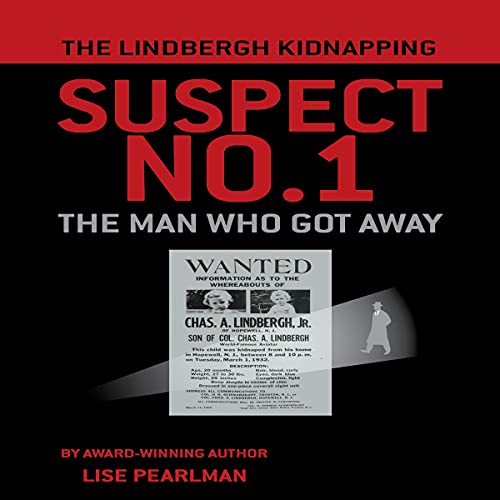
Bruno Richard Hauptmann was tried, convicted and executed for the kidnapping and murder of Charlie Lindbergh, son of famed aviator Charles Lindbergh and his wife Anne. However my guest, Lise Pearlman, author of The Lindbergh Kidnapping Suspect No. 1: The Man Who Got Away believes that not only was Hauptmann innocent, but something far more sinister likely happened to the little boy, at the hands of someone inside the Lindbergh’s New Jersey farmhouse on that fateful night of March 1st, 1932.
More information on Lise and her books can be found at her website here: www.lisepearlman.com
Interview transcript:
Erik: Hello all Erik here. So I decided to turn back the most notorious clock this week. I have released a number of controversial interviews over the years. The one about Lee Harvey Oswald comes to mind. I got a few nasty emails about that one. Now, don’t get me wrong, the overwhelming feedback that I get is positive, and I’d like to think that it goes without saying that not every guest or subject matter is going to appeal to everyone all of the time.
But one of the things that makes this show stand out amongst the hundreds and hundreds of true crime and history podcasts out there, I hope anyway, is that my guests, by and large, have spent an awful lot of time researching their respective topics. Years, sometimes decades, and often they’ve uncovered some really fascinating bits of information that may cause us to question what we thought we knew about a case already.
I say this because I’m from Minnesota where Charles Lindbergh has been celebrated for almost a hundred years. His childhood home is a historic site. I’ve been there multiple times. Little Falls is a lovely town. By the way, Minnesotans historically have been proud of Lindbergh and his aviation achievements and the fact that he is a native son.
The main MSP airport terminal is known as the Lindbergh Terminal. A replica of the Spirit of St. Louis even hung from one of its ceilings. So I grew up thinking he was one of Minnesota’s greatest heroes, the most well-known Minnesotan in the world. Now, I understand that that is actually Prince, but I’ve learned over the years about Charles Lindbergh’s dark side as many of you have as well, and he definitely had a dark side.
When this interview you are about to hear first aired, most of the emails and comments I got were hugely supportive of the author, but there were a handful of listeners angry that Lindbergh’s accomplishments were being diminished by what they perceived as a character assassination. So my take on anything controversial is just to read, read, read, read.
If you don’t like the author and don’t wanna buy the book, borrow it from the library and still read it before you formulate an opinion on an author based on a one hour podcast episode. If you do like the author, buy their book and support their future work. But read and question and keep an open mind.
Alright, onto this encore episode of Most Notorious, my interview with Lisa Pearlman.
Welcome everyone, to another episode of the Most Notorious podcast. I’m Erik Rivenes. Great to have you here. So I am very excited to have as my guest today bestselling author Lisa Pearlman, a longtime California attorney. She also served as the first presiding judge of the California State Bar Court, amongst other accomplishments in her long and distinguished career.
She’s here today to talk about her brand new book called The Lindbergh Kidnapping: Suspect Number One: The Man Who Got Away. So kudos to you. First off, for tackling such a famous subject, one that has been written about a lot in the last few decades. What angle did you decide to take on the Lindbergh kidnapping murder case that other writers hadn’t taken before?
Lise: Thank you. I started out just wanting to get a handle on the case because there were two different perspectives that various authors had put forward. Biographers of the Lindberghs and some historians decided that the trial, which was a huge media event at the time, in 1935, that the defendant Richard Hauptmann, Bruno Richard Hauptmann, was guilty and deserved to be executed, which he was the following year, and a much smaller number who were insistent that he’d been framed and that this was one of the worst miscarriages of justice of the 20th century.
And I could not even write about it saying, well, some people say he was guilty, and some say he was innocent as a judge without having a really good handle on how I felt about the evidence. So I did read a number of books and I did my own original research. And I concluded, actually before I wrote just one chapter in my first book, the Sky’s the Limit, that had a chapter or piece on these early 20th century trials of the century, that I had a different take on it than anyone else. That I did agree with those who thought that Lindbergh was complicit himself. I agreed with those who thought that Hauptmann was actually innocent and not part of a kidnapped gang. And that it was much darker of a tale than anyone else had imagined. At least, any books had been written about, and that I would write my own book.
And I did that. I started on that over a decade ago and put it aside. And then in 2017 I revisited it and got additional research done, which it was very much needed, primarily by my daughter, Jamie Ben, my principal research assistant, and uncovered a lot of material that other people had not focused upon.
Erik: Yeah, you’ve come to some fascinating conclusions in your book, but before we get to the abduction and murder of little Charlie, let’s address Charles Lindbergh, his father first. Many of us, no doubt, have this idealized version of the famous aviator in our minds, this heroic, courageous man who made the first nonstop flight across the Atlantic Ocean, New York to Paris, became an international celebrity.
Lucky Lindy could do no wrong. People found themselves starstruck in front of him, but his real life personality did not really match this celebrity version. Would you agree?
Lise: Absolutely. He was a loner. He had a very weird sense of humor, if you can call it that. He liked to pull what he called practical jokes, but they were often sinister in nature and it was a habit that he kept up for most of his adult life.
So there was that. Including a friend when he was, when they were both barnstorming, another pilot, who wound up in the hospital because Lindbergh thought it would be funny to substitute kerosene in a water pitcher by their beds in the shared room that they had in the boarding house. And his friend took a big gulp and almost died.
The reason behind it was that Lindbergh wanted to teach him a lesson because he never refilled the water pitcher. And it was one of the few practical jokes that Lindbergh many years later said, well, I think maybe I should have been more moderate.
But a lot of this, well, that one actually hit the newspapers right after his flight to Paris, but most of them did not. And most of the pilots who knew him and knew of other mean tricks that he played kept silent about it for many years. But they wound up, some of these stories, in various biographies. But most biographers, actually all the ones I read, would only incorporate two or three examples and maybe a couple more.
But if you put them all together, it’s a much darker picture.
Erik: Yeah. He was very antisocial. Right. He wasn’t a fan of public speaking.
Lise: He often got angry at the press for hounding him. He was angry at the press when he was, you know, in his late twenties, early thirties. Ultimately, during World War II, he became the chief spokesperson for America First, and then he was happy to make speeches. So that evolved.
Erik: Right, right. Would you mind telling us about how he met his wife, the birth of their child, and how they ended up on a farm in New Jersey?
Lise: Well, Lindbergh flew in May of 1927 and the timing of that was very propitious for him to rise as this megastar because the army and Navy, after World War I, were not anxious for an air force to be created.
And when he flew across nonstop, they all of a sudden realized in Washington how future wars might involve airplanes dropping chemical weapons or otherwise used, or much more than for reconnaissance as they were used in World War I. And so they used Lindbergh as the poster child, essentially, of creating airports across the country and honoring him with parades and all that to get the public behind building up an Air Force.
And one of the key people involved in that was Morrow. Dwight Morrow. And Dwight Morrow was named by the President Calvin Coolidge as the ambassador to Mexico. And at the time there was a lot of tension with Mexico that they thought might erupt into war. And so Morrow got the brilliant idea of asking Lindbergh to be a peace offering, essentially to fly from Washington, DC nonstop to Mexico City to show the friendship between the two countries.
And Lindbergh agreed to do that. And that happened in December of 1927. And that was when Lindbergh then met Dwight Morrow’s family, which included three daughters and a son. And Anne was the second daughter. He didn’t take a lot of notice of Anne on that occasion because he was much more enamored with her older sister Elizabeth.
But the family took him in and he went on a vacation with them to their summer home in Maine the following year. And Anne was immediately enamored of him and started taking flying lessons from Lindbergh. And he wound up proposing to her and marrying her, and he was very private and the family was a little bit concerned.
I think by the time they got to know him a little better because he would pull tricks on them. Like they’d go canoeing and he’d pull the boat out from under and they’d fall in the water. And they were a little taken aback at some of his antics, but they were also concerned because Anne seemed totally under his sway, the way they planned the wedding.
Everything that happened from then on was dictated by Charles, different from how the family would’ve liked things to go, but they wound up after they were married living with the Morrows at their estate.
Dwight Morrow was very wealthy and had an estate in Englewood, New Jersey, and that was where their first son was born at her parents’ home. And there was a lot of coverage of this first child because Lindbergh himself had been the subject of news reels since the spring of 1927 when he got engaged and then married Anne.
There were news reels about the couple because she flew with him, and they were trying to set new records of speed between different cities. And then when she got pregnant, that was covered very exhaustively.
And one of the things that happened in that pregnancy was of great concern because Lindbergh decided to try to set a record of a flight from Los Angeles to New York with Anne when she was seven months pregnant. And Anne became very ill on that flight for lack of sufficient oxygen, primarily. And when they landed, she was rushed off to the hospital and then in seclusion for two months before their child was born.
And there was a lot of speculation in the newspapers that maybe something had happened to the baby in utero. After the baby was born, there weren’t that many pictures allowed by Lindbergh, but he wanted to leave her parents’ estate and live in his own home.
And so he found some land near Princeton, New Jersey, central New Jersey that he purchased. And they had a home built there, a farmhouse. And he and Anne would go there on weekends starting basically in January of 1932. And that was where they were living, part-time because they only spent weekends there still in March.
That was where they were when the child was kidnapped.
Erik: There were some concerns with little Charlie that he might have some physical ailments, some physical limitations, right?
Lise: The pediatric records have never been disclosed as such. So some of the concerns about little Charlie’s health are not completely known.
But his pediatrician did give a statement and wrote a letter to the boy’s grandmother about his health. So we do know some things. He suffered from rickets. He was taking a heavy dosage of vitamin D for that. He had very pale white skin that was dry. He had his toes curled in. He may have been bow-legged.
He didn’t stand straight for the doctor at his last checkup, which was February 18th, 1932, and he was oversized for his age. At that point, he was about 20 months, not quite, when the doctor saw him.
And he had an oversized head of what the doctor called a square head. And the fontanel that normally closes by then was not yet closed. So there’s speculation that the boy might have been hydrocephalic, and hydrocephaly is fluid on the brain that sometimes is caused by problems in utero, which could occur from lack of sufficient oxygen. So that’s a possibility that has never been fully established.
Erik: What was their relationship to their son?
Lise: The relationship to the son was different for each parent. Anne was totally taken by her son, little Charlie. She loved spending time with him and she didn’t get to spend as much time as she would’ve wanted to because her husband kept pulling her away.
When the boy was several months old, Charles Lindbergh decided that Anne needed to have intensive flying lessons. So they would leave early in the morning and come back after the little baby was already put to bed for the night.
And the summer of 1931 when little Charlie was about 13 months old, Lindbergh talked his wife into a two and a half month trip to the Far East by plane and went to China and Japan, and they left their son behind with the nanny and her parents.
When they came back in the mid-October of 1931, the little boy didn’t even recognize his parents. So there was that concern, and Lindbergh seemed not to mind that at all because once he was back home, he insisted on a very rigid schedule that had his son being put to bed before Lindbergh was usually home for the evening.
Erik: You write in your book that Will Rogers, the famed satirist, visited the family and he was watching Charles interact with his son and he was a little taken aback, right?
Lise: I’m not sure if Will Rogers was taken aback. He told it as if it were a funny anecdote. But Rogers visited. Rogers was an amateur pilot himself and a great admirer of Lindbergh.
And he and his wife visited the Lindberghs at Anne’s parents’ estate where they spent most of their time still in Englewood, just about three weeks before the kidnapping.
Rogers noted that they were sitting in the living room and Anne was sitting on the floor playing with blocks with her son. But sometimes the little boy would get up and start to walk across the room, and every time he did that, Lindbergh would grab a pillow from a chair or a couch and throw it at the little boy and knock him down as if he were a carnival doll.
And what Rogers said in his column that he wrote about this is that he thought the little boy was very cute because the third or fourth time that happened, he just sat down on his rum ball by himself before the pillow hit him.
But I was very concerned reading that because this was right around the same time of his last pediatric visit. And with rickets, the little boy had weak bones, and the notion of knocking him down on purpose seemed to me to be pretty hostile.
Erik: Yeah. So would you mind walking us through the hours that led up to the disappearance of Charlie?
Lise: Let me go back a little bit to the weekend before he disappeared. Lindbergh had his attorney and best friend Henry Breckinridge and Breckinridge’s wife visiting at the farmhouse that weekend. And the Breckinridges left on Sunday evening.
Lindbergh decided on Monday morning, the following morning, that he was heading back to New York where he spent a lot of time volunteering at that point at the Rockefeller Institute for medical research and left before his son got up. So the last time he saw his son was Sunday evening.
The little boy had a cold and all weekend long they’d been giving him medicine, which caused him to go out pretty quickly each time.
Lindbergh called his wife from New York on Monday and told her that he wasn’t gonna come back on Monday night. He would come back on Tuesday. But he told his wife that she should stay at the farmhouse, even though normally they only spent weekends there. Instead of going back to her mother’s home in Englewood, New Jersey, and for the sake of their son that she should stay where she was.
Well, this farmhouse was very isolated. The only other people at the farmhouse with her were the Whateleys, who were the cook and her husband, Ollie Whateley, who was kind of a butler chauffeur, and the nanny.
And Lindbergh didn’t come home that night, and then Tuesday morning he called again and told her that she should stay there, and that she should stay another night and made sure she gave their son his medicine and that he would come home later, which is a bit bizarre, all of this, because unbeknownst apparently to Anne Lindbergh was supposed to be the guest of honor at the hundredth anniversary of New York University at the Waldorf Astoria in New York that night, March one.
But instead, he said he was coming home for dinner. And so she stayed with the nanny and the other couple, and the little boy was put to bed according to the routine that Lindbergh had established, which was very strict.
He was supposed to be in his room by seven to get him ready for bed and put him in his crib for two hours from eight until 10:00 PM. At 10:00 PM the nanny was allowed to come back, wake the little boy up, let him sit on his potty and maybe give him a snack or milk or something, and then put him back to bed for the night.
And so that was the routine they were supposed to follow, and that’s what they did follow. So Anne and the nanny put the little boy to bed and the last person to see him was the nanny Betty Gow at just before 8:00 PM. And she said he was sleeping very soundly.
She went downstairs and when Lindbergh came home around 8:30 that night, he and his wife had dinner. They sat briefly in their living room, and then they went upstairs to their bedroom without checking on their son. And the son’s nursery was adjacent to their bedroom except for the master bath, which connected the two.
The nanny had been meanwhile spending her time over the garage in the apartment of the Whateleys, who were the couple that lived there permanently. And at 10:00 PM she came back, Betty Gow the nanny, to wake her charge and take care of him for the night. And when she got back to the nursery, there was no boy in the bed. The crib was empty.
The very first thought that the nanny had, Betty Gow, was that Anne must have taken her son out and had him in her own bedroom. So she stopped to ask Anne at the master bedroom.
Anne said, I don’t have him. Check with the colonel, which is what they called Lindbergh. And then Betty Gow went downstairs to Lindbergh’s study, which is just under the nursery, and asked him, and he acted surprised and ran up the stairs. Glanced at the crib and then told his wife and the nanny, essentially that kidnappers must have his son.
He ran into his master bedroom closet, pulled out a rifle, and they immediately started a search and he asked the Whateleys to help them. He had Ollie Whateley call the police, and that was when all of the investigations started.
Erik: Lindbergh went out with a flashlight, right? It was very dark, but he almost immediately discovered the ladder in Chisel.
Lise: Well, there’s conflicting stories about that. Betty Gow, when she was interviewed by the police, said that Lindbergh and Ollie Whateley went out immediately while the women searched inside.
Lindbergh himself said that he didn’t go out until maybe 15, 20 minutes later. But then he sent Whateley to the store, to town, to purchase flashlights.
So the inference is that they didn’t have any, at that point. Whateley ran into the police on their way to the house as he was headed to town. And because the police had flashlights, he returned.
These are the two local police, the Hopewell police, which is the closest town. And the Hopewell police used their flashlights with Lindbergh to find the ladder in the yard, which was rather odd because Lindbergh led them straight to it.
The ladder wasn’t next to the house. The ladder was about 75 feet away in tall grass, which was pretty muddy. And it was very cold. And of course it was very dark except for the flashlights.
But that wasn’t exactly the story that told the state police. When they arrived a few minutes later, they had also been summoned. And when the state police arrived, Lindbergh said that he found the ladder in the yard.
So there are conflicting stories from the very first night, but when you unraveled them, I think that Betty Gow was the most consistent and made the most sense.
So it was her timeframe. I believe that they ran outside immediately after Whateley was summoned. So that would be about 10 past 10.
Of course, Betty Gow had discovered the absence of the boy at 10 o’clock.
Erik: And he pretty quickly found a ransom note, right?
Lise: Well, the ransom note was another very odd thing. Betty Gow, the nanny, did not see any ransom note when she was in the room and did not see any ransom note when she was in the room.
Lindbergh later testified that he found the ransom note on his first or second visit to the room.
He couldn’t have found it on his first visit because that was before the women searched the room. And so it was supposedly found on the windowsill of the nursery, unopened.
And Lindbergh lacked the curiosity to open it before the police arrived, so he insisted that it be kept until the police arrived for them to open.
The fingerprint expert could find no fingerprints whatsoever on that note.
But it’s also really curious, of course, that Lindbergh’s first reaction when he ran into the room was that his son must have been kidnapped when he hadn’t even opened the envelope and nobody had seen it.
Erik: So normally the family had a Scottish terrier named Skean, which slept in the room with little Charlie, but coincidentally he wasn’t in the room with the child that night.
Lise: Well, I don’t know that it was coincidental, and that’s one of the many things that the police did not investigate properly.
I think it was highly suspicious that Skean wasn’t there, that Lindbergh had two dogs. One of them, Wago, lived with the Whateleys on the premises of the farmhouse. Wago was there, but in the kitchen at the time that they assumed the kidnapping took place.
But Skean would’ve been lying under the crib. And he was a very noisy dog. It would yap if there were any intruders bothering his little baby.
It was supposedly the dog went missing at Morrow’s estate when Anne was chauffeured down on Saturday afternoon because she came on the Saturday before the last Saturday of February and stayed until Tuesday. And normally they would’ve brought Skean with them, but because he wasn’t there, she did not.
What is odd is that there was a newspaper report a few days later that a dog owned by the Lindberghs—and they had the name wrong. And I think they had the breed wrong too, so it wasn’t absolutely clear, but they only owned two dogs—was at a kennel in Princeton on Saturday and stayed there for a couple of days.
No one ever investigated among the police, ever investigated that story to determine whether that was actually Skean, whether it was true. Because if it was true, it meant someone intentionally sidelined the dog, but it was never investigated.
Erik: Yeah. Really odd. One of the things that puzzled police was that when they arrived and investigated the baby’s room, it was nothing overturned, or put out of order. There was actually a single broken lock on one of the three windows in Charlie’s room. And there was actually a stein sitting on the windowsill of that window.
Lise: Yes. Untouched. Right. There was a stein sitting on the windowsill, but there were matching windows on either side of the fireplace on the east side of the house.
And so there were those two windows for the nursery and there was a French window on the south side, which was the closest to the crib.
The nanny had not been able to close the bolt on the shutters to one window on the east side, and that was the only one that was accessible from the outside easily because it wasn’t bolted. And somehow that was the one that kidnappers supposedly used. So one of the first questions the police had was, how would anyone know that without inside help? This is a brand new house.
And the man who actually installed all the windows said he had checked them all just a couple months earlier and everything was in fine working order. He could not understand why that bolt wouldn’t close. The shutters were actually taken down by the police and examined and never returned. So they did not bring them back.
But one private investigator was told that the bolt had been made unusable with a screwdriver. So that was an odd thing that was never pursued either.
Erik: And you wrote that Lindbergh had recently hired a handyman to come over and do some repairs to the house. But even though he had known that that lock didn’t work, he still didn’t tell the repairman to fix that one thing.
Lise: That’s right. And in fact, the window, the bolt, had not worked since early February at least, because Anne had noticed that before, but they tried to use those windows to bring in fresh air into the room twice a day.
So it was very odd that Lindbergh did not tell a repairman, this needs fixing.
Erik: So police arrive at the scene. You state that in Lindbergh’s autobiography, which he wrote years later, that he had said that he kind of passively stepped aside and let the police take control of the investigation.
But that’s not what really happened, was it? I mean, Lindbergh was commanding firm in what everyone’s jobs were to be in this investigation. And he basically gave the orders to law enforcement and they didn’t really argue back.
Lise: Well, Lindbergh was officially given power over the state police by the governor of New Jersey very early on.
His lawyer, Breckinridge, moved into the farmhouse with him and the two of them took charge. And the head of the state police, Colonel Schwarzkopf, followed Lindbergh’s directions from almost the very beginning.
And one of the things that happened is that Harry Wolfe, who was the police chief for the town of Hopewell, who had been the very first responder, was removed from the case. And technically he didn’t have jurisdiction over a kidnapping from the house itself because Lindbergh’s property straddled two counties and the house was in the next county.
But Harry Wolfe was very suspicious. When he entered the room, it did not look to him like a crime scene. Everything was too perfect. None of the furniture had been moved. It made no sense to him. But he was quickly taken off the case, and so was Oscar Bush, who was an early investigator who also thought that the ladder was a ruse and that this involved an inside job.
Both of them were taken off in favor of the state police, and the state police at that point did not even have a crime lab. They were ridiculed by county detectives because they really did not have a lot of expertise, and they mostly dealt with minor crime. They were not effective against serious crime at that point.
So a search was organized, but Lindbergh turned down assistance from some agencies that volunteered to help. He was very strict and very specific about what areas were to be searched and which areas weren’t. Well, he searched somewhat, but the police under his control essentially did not do thorough searches at all.
And one of the things they didn’t follow up on was a neighbor’s son who saw a man at dusk on the night of the kidnapping driving a car at the foot of the Lindberghs’ driveway with a ladder in it, a ladder over the passenger side, a sectional ladder.
The young man could not see the fellow’s face because it was partially obscured by a fedora, but he noticed that the man was wearing like a city dweller, heavy winter coat.
And the neighbor, Ben Lucas, also noticed what kind of spokes there were on this car. He was able to determine it was a 1929 Dodge with wooden spokes on the wheels, that it had a spare tire attached to the back. Very specific about that. And he also saw that the license plate on it was local. It was similar to his own license plate of his family’s car.
And the police started searching with him for someone who owned a car of that description in the county. And it shouldn’t have taken too long to find potential suspects. Halfway through that search, the police quit. Lucas could never figure out why they didn’t follow up, but they didn’t. And the man that he saw was slim and looked American.
And there were authors in the 1990s who decided that was probably Lindbergh himself at the foot of his own driveway with a ladder in his car, but that was never pursued.
Erik: One of the troubling things about the investigation was that from almost the very beginning, Lindbergh behaved nonchalantly amongst all of the chaos. His wife was absolutely heartbroken, but he made himself busy playing practical jokes on the police officers that were stationed there to help him find his kidnapped toddler.
Lise: That’s right. And his friend Breckinridge, he was pulling jokes on him too. Putting ice down the back of Breckinridge and gave Breckinridge a super scare because when they went out in Lindbergh’s plane looking for a boat that they were told the ransom ware might be on with his son. And this was early April of 1932.
Breckinridge asked if he could fly for a little while because he was also an amateur pilot and Lindbergh had rigged the, he knew that would happen. And so he had rigged the plane so that the steering mechanism was backwards, so that if you wanted to turn right, it would go left and left it go right and up it would go down.
And Breckinridge was beside himself, couldn’t figure out what was going on until Lindbergh took over and handled it from then on. And this is while they’re supposedly searching vainly for his missing son.
Erik: So the ransom money, would you tell us how Lindbergh handled that, and specifically how he handed the money off to this mysterious figure nicknamed Cemetery John?
Lise: Well, there were a number of ransom notes, and my assumption was that this was a wild goose chase. In fact, there was a psychiatrist who analyzed the notes, and it was very odd because normally if the child is being held for ransom, then the culprits want to meet, get the money, give the kid back, and go on their way.
But instead, this was a series of notes, one after another, assuring the parents that the child was still healthy. It was very complicated. The instructions on how to meet up with their representative, whom the press would later call Cemetery John. All of that led up one psychiatrist who analyzed it to come to the conclusion that this was essentially a sinister game being played, that the child was already dead, which turned out to be the case.
But there was a meeting in a cemetery. You may have asked about Cemetery John. Lindbergh had a series of go-betweens, and the first one was a small time mafioso who then was replaced by a retired school principal who was more famous. He went by his initials, JFC, or JC, John Condon. And Condon was the one who was given $50,000 in bills to bring to Cemetery John in exchange for getting information on how to find the little boy supposedly still alive.
And Condon winds up meeting twice in two different cemeteries with Cemetery John. And the second one gives Cemetery John a box full of money, which they had already recorded all these notes so that they knew they could tell when they were spent, and only got a piece of paper in exchange that was supposedly directions to where to find the child on a boat. And that turned out to be a wild goose chase. The money was already given out and started showing up in various places and no little boy was found at that point. This is early April of 32.
In May, six weeks later, the child’s body was found and it was determined that the decomposition was such that the child was dead for at least two months.
Erik: So in kidnapping cases you suggest in your book authorities make it a habit to demand proof that the victim is still alive, and that’s in exchange for the money that they have agreed to hand over. But not Charles Lindbergh. He didn’t feel that it was important that he and his wife got verification that little Charlie was okay.
Lise: That’s right. And that was really odd to both the federal authorities and the state police and to Condon himself.
It’s like, why don’t you want me to insist that he’s alive before I give this money? Oh, I trust them. Essentially. I wanna show my trust in the kidnappers. It was pretty lame, I think.
Erik: So, who discovered the body?
Lise: The body was discovered by a trucker who was on his way from Princeton up to Hopewell and stopped because he needed to relieve himself. And he was African American. And I think even at that time in New Jersey, there wasn’t any place that would welcome him to stop.
So he stopped the truck and went into the woods. And when he was standing under a tree, he almost kicked away something that his foot brushed against. And then he realized it was a half, almost buried, not quite buried body covered with leaves and a little bit of dirt under the tree.
And he called to his coworker who came running from the truck, and they both concluded that it could be the Lindbergh, maybe because this was only less than five miles from the Lindbergh estate. And of course, that had been the subject of a national search for the last couple months.
So they went off to find the local constable. And then the constable came back to view the child himself and brought in the state police who were then having a temporary headquarters at the Lindbergh farmhouse.
Erik: So an autopsy was performed by the coroner and it didn’t go incredibly smoothly?
Lise: No, there wasn’t a full autopsy at all. At the time that the body was found, Lindbergh was off on another search with a new go-between named Curtis from Virginia off the coast and the Atlantic further south than the prior search had been. And so he was on his way back. The police brought the corpse to the morgue in Trenton. And the coroner and the medical examiner began what they called a looksie, which meant that it was a preliminary autopsy. They did not cut open the chest as they would in a full autopsy. And that was the night of May 12th, and had been found in the afternoon.
This was a very, very decomposed body, but the face was not decomposed, so that was odd. In fact, when a policeman had turned the body over, the face was still white and the features were fairly recognizable.
When they brought it into the morgue, it had already started turning completely dark like the rest of the body except for the right foot, which was also still had flesh on it, which most of the body did not, and which had curled toes that overlapped.
So when they brought in the nanny that night to identify the body, she was able to identify it both from the toes and the facial features, including the 16 teeth because the child’s teeth had come in an angle and she recognized them.
The other thing she recognized was the T-shirt that the corpse was wearing was wearing two T-shirts, and one of them was handmade by the nanny, so she was able to identify the body. But one of the major problems, aside from how decomposed it was, is that the body had also been desexed and most of its organs were missing.
Erik: And there had been some confusion earlier because despite the fact that recent photographs of little Charlie had been taken, Lindbergh insisted that a much older photograph be distributed to newspapers and law enforcement agencies.
Lise: Absolutely. And that is one of the oddest things to this day. People’s image of Lindbergh’s son is the one that Lindbergh circulated. It was the one that was put on the, or two were put on the poster that was distributed nationwide and overseas. But these were photos taken in the summer of 1931 when he had just turned one.
The little boy by March of 32 was 20 months old, but he had also grown pretty fast between the age of one and 20 months. And so he then had an oversized head, an oversized chest, was 33 inches tall.
The poster that Lindbergh had distributed by the police said that he was only 29 inches tall when he disappeared. Also said that he had curly hair. He’d actually just gotten his hair cut the week before he disappeared. So there was a misleading description that was imprinted in most people’s mind.
And Lindbergh, as I said, had not allowed very many photos. In fact, he hadn’t allowed any photos to be taken by the press since October of 1931. So when the New York Times asked for a photo, Lindbergh gave them a photo, which was of the similar vintage as the ones on the poster.
And the New York Times printed that that photo was taken two weeks ago when they printed it on March 3rd, 1932. And it wasn’t taken in February of 32. It was taken in June of 1931. So it was very misleading and the child was much bigger than that.
And there’s actually a diary entry made by Anne Lindbergh that she was very upset about these ubiquitous photos of her son at an earlier age because it was erasing the memory in her mind of what he looked like when he disappeared.
Well, there were two other, I should mention that, that Ada Breckinridge, Breckinridge’s wife, described little Charlie the weekend before he disappeared as looking closer to three than to two. And he was only 20 months. And his aunt, his great aunt, also made a similar comment about how he was oversized and more mature looking than his age.
Erik: So police start recovering some of the ransom money and suspects begin emerging in including a suspicious character named Arthur Hitner, right?
Lise: Well, Hitner was somebody known to Lindbergh and comes in and out of the story several times, but seems to not interest the police very much at all. They, you know, he gets arrested and let go. He winds up being in jail at one point and talking about the Lindbergh case and how his car was used as part of the kidnapping. But, you know, it was stolen from him and then he got it back and very odd stories, but they were never really fully pursued.
My daughter did some research which led her to conclude that Hitner was actually a man of many disguises, and that one of them was someone who went by the name of Jacob Nocki, who also comes in and out of the story. And so I have a chapter in my book about them, and it may well be that some of those gold certificates were spent by Hitner and he was just never pursued for that.
Erik: There are so many shady figures in this story, right? It’s just wild that Lindbergh enlisted Owney Madden, the infamous New York mobster, to help him find his son.
Lise: Yeah, he did. And in fact, there are other mobsters who come in and out of the story. Al Capone offered his services. He was then in jail and he said, if you let me out, I will help find, I can make sure to find the Lindbergh baby. But Lindbergh wanted to take him up on it, but the cooler heads prevailed.
Erik: So how did Bruno Richard Hauptmann eventually surface as a suspect?
Lise: Well, actually he went by the name Richard Hauptmann. Bruno was his given first name, but his wife didn’t even know that, but that was his first name. He lived in the Bronx. He was friends and a business associate with a fellow named Isidor Fisch, who was also involved in this story.
But what happened is that the New Jersey police started getting ridiculed for not having solved this case after spending more money and more time on the investigation than any previously. And by the fall of 1934, which is two and a half years after the child disappeared, they wanted to solve it very badly. And some money had been turning up. Well, some of the ransom money had been turning up on occasion and had not been pursued to its source. In fact, one person had turned in $3,000 worth of the ransom in May of 33 and had not been caught. So there was a lot of ridicule overall of this. So they actually doubled down in their efforts and the New York police were also involved.
And in September of 1934, Richard Hauptmann had a $10 gold certificate that he spent for a little less than a dollar’s worth of gas in his own neighborhood. Now, gold certificate was a bill, like a regular $10 bill that had the backing of gold held by the government to assure its value. And President Roosevelt had taken those bills out of circulation, which had a stamp on them to show that they were gold certificates.
They were taken out of circulation on May 1st, 1933, so that American dollars were no longer backed by gold. And as a consequence, it was easier to spot for anyone receiving a gold certificate after that. It was a misdemeanor to spend them. The gas station attendant when Hauptmann used a $10 gold certificate wrote Hauptmann’s license number on the bill. It was then turned into the bank. The bank turned it over to the police because it was on a list of ransom money.
And the police just checked with the Department of Motor Vehicles and got Hauptmann’s address and quickly arrested him and found that he not only had that bill and a couple of others in his wallet, but he had hidden in his garage $14,000 worth approximately of money from the ransom money that had been paid to Cemetery John in April of 1932. Hauptmann was immediately arrested and charged with extortion.
But that was in New York. The question of prosecuting someone for murder would have to be handled in New Jersey, and they didn’t have any evidence at the beginning that he was implicated in the kidnapping murder itself.
Hauptmann was beaten and interrogated, and he stuck to the same story, which was that he did not even know where the Lindberghs lived, that he got this money in a shoebox that was left by his friend, Isadora Fisch, when Isador Fisch went back to Germany in December of 33, and Hauptmann thought it was just important papers that he was supposed to keep for his friend until he returned. Well, it turned out that Fisch died in Germany in the summer of 1934, August.
Hauptmann said there was a rainstorm and the closet where he had Fisch’s box got drenched. So he pulled out the contents and remembered, oh wait, this is the box that belonged to Isidor. He opened it up and he said that was when he found this money inside.
And since Fisch owed him money, he felt that he was entitled to some of it and that he was planning on giving the rest of it back to Fisch’s family. Whether that was true or not, never got tested because the police intervened. So they did not believe him, and that became known as Hauptmann’s Fisch Story.
Erik: I interviewed Adam Schrager a few years ago about his book The 16th Rail, which I’m sure you’ve read, and the book was about Arthur Koehler, the wood expert, the nationally renowned wood expert. So Koehler matched wood in the ladder with wood from Hauptmann’s shed, right? Not from the shed?
Lise: No, it wasn’t from the shed. There was nothing in Hauptmann’s garage that matched the wood in the ladder. What Koehler testified to was that a board in the attic floor above Hauptmann’s apartment was partly missing. And the part that remained matched one of the rails, rail 16, in the ladder that was supposedly used in the kidnapping.
So the police put on a case that Hauptmann built the ladder and the proof was that this rail matched a section of wood in the attic there that was disputed. There were other, the defense did have a couple of their own experts both at trial and one who looked at it while the case was pending on appeal who disputed Koehler on that.
Erik: When I interviewed Adam Schrager, he said that no one questioned Koehler’s findings. You obviously disagree with this, right?
Lise: As one example, he said that the board from the ladder fit perfectly with the space left from the missing board in the attic. It didn’t actually. It did not. I mean, there’s some discrepancies and one of the things that was pointed out by the defense experts at trial is that rail 16 was a 16th of an inch thicker than the remaining board that was part of the attic floor. The other thing is it was narrower.
One of the assumptions that Koehler made is that for some reason, and the whole situation is rather peculiar because what they’re assuming and what Koehler got the jury to believe was that an experienced carpenter, which Hauptmann was, with wood in his own garage and cheap wood, Pinewood, available at a nearby lumberyard, decided to go up in the narrow closet in his hallway, which only accessed the attic by crawling up through a trap door, to go up in there and pull up part of one floorboard and then plane off the tongue and groove of that floorboard and then cut it because it was longer than he needed down to a little over six and a half feet in order to use in a ladder, which everyone described as a slipshod ladder that could not even hold a man’s weight and it would’ve cost him 13 cents to buy a piece of wood.
So it was a lot of effort, supposedly, to go through the alternative theory is that which is what later investigators assumed on behalf of the new governor of New Jersey was that the police planted the evidence in the attic and claimed the rail to make it look like it had been planed down from wood in the attic.
Erik: One of the many interesting aspects to all of this, Hauptmann, before he lost a lot of weight in jail, he was heavy and the ladder was flimsy, right?
Lise: He weighed about 175 to 180 pounds at the time. And the police tested, the state police tested, that ladder in the yard immediately when they had no suspects, and they found that it wouldn’t hold more than 125 pounds, including the weight of the child, without cracking. So the notion that somebody weighed 180 pounds would kidnap a 27 pound kid and rely on that ladder as his entrance and exit was problematic from the get go. It would’ve broken. And to navigate a ladder while carrying a giant burlap sack is insane.
Erik: Well, they tried that. They tried to replicate that. They didn’t have a burlap bag because they didn’t know about it yet.
Lise: Right, right. When they tried, but they did carry a weight down and the policeman who tried to do that fell or dropped his package every time. The other thing is the burlap bag, which is part of the evidence against Hauptmann, is only 36 inches long. The picture they used of the child at trial was also the same vintage of the others from his first birthday. So the jury was led to imagine that this smaller baby was put in the burlap bag. They were not asked to imagine that a 33 inch child was placed in a 36 inch bag.
And when you think about a pillowcase, which is about the same size, you can’t even, you don’t get any purchase on it. If you put something in that’s almost as big as the pillowcase, he couldn’t hold it in one hand. There’s no way that that really, you could envision that if you actually envisioned the child as he actually looked. And it was also muddy outside, and there weren’t any really muddy footprints in Charlie’s room. There were some smudges in the room, but not full footprints when the police arrived, but not enough. And in fact, the governor’s chief investigator later on said that where they were placed was very odd. It did not make sense.
But one of the things the police did notice right away is that there was no imprint from dropping a baby, which was the theory at trial was that the baby was dropped, and he wasn’t really a baby. He was a big toddler. But the toddler was dropped on the way out of the house, and that’s how he died instantly on that property.
Well, there’s no mark of anything being dropped under that window in the mud, and there also wasn’t a deep enough imprint from the ladder to show that it carried any weight.
The imprints from the feet of the ladder were so shallow that the first conclusion was it had not really borne any man, but that investigator was never asked to testify.
Erik: Right. So we don’t have a lot of time here to get into the details of the trial. And they are all in your book, but Hauptmann, of course, was found guilty and was executed. But I would like to ask you about another aspect to this whole case, which plays to motive. It revolved around a man named Dr. Alexi Carrel. What was his relationship to Charles Lindbergh and how do you think it tied into the kidnapping?
Lise: Well, Alexis Carrel was a world renowned medical researcher who headed a surgical research department of the Rockefeller Institute in Manhattan, which also had a branch office in Princeton, New Jersey, a branch facility. And what he specialized in was vivisection and in particular vascular surgery. He had won the Nobel Prize in 1912 for his ability to sew arteries and veins together with a new technique that revolutionized vascular surgery.
And Lindbergh met Dr. Carrel in November, the end of November of 1930, because Lindbergh was interested in finding out if there was anyone who was trying to do experimental surgery to repair human hearts and potentially for organ transplants because Lindbergh grew very concerned about his sister-in-law, Elizabeth, who had a defective heart valve since she had rheumatic fever when she was a child, and she was not given a likely long time to live. This was, as I said, in November of 1930. And when Lindbergh was introduced to Dr. Carrel because of his expertise in vascular surgery, Carrel told him that he’d been experimenting for 20 years with dogs and cats and other animals in trying to maintain organs harvested from a body so that they could later be transplanted. And this was something that had not been yet been achieved.
And he showed Lindbergh the device that he was using and how frustrated he was about the device because whenever he placed a tiny organ, like a thyroid in it, within a few days it died. It became necrotic. And Lindbergh was a mechanical genius. And he looked at the device and said, I think I could improve on that to make it less likely to be invaded by bacteria.
And so Lindbergh started working on improving this device for Dr. Carrel. And it was a mentor mentee relationship. Medical researchers were not that advanced in working with biomedical equipment. And so Lindbergh added a dimension to their work that was very valuable, and they worked together for several years and the public was unaware. Lindbergh’s volunteering at the Rockefeller Institute under Carrel’s leadership in his lab, and my belief is that Carrel, well, it’s not just a belief. He actually worked not just with animals, but experimented with humans. He was not licensed as a doctor anymore, but he had obtained, I think, some cadavers from prisoners and maybe from hospitals, but it’s, there’s also evidence that he may have obtained small children from institutes in New Jersey. There is a letter that is referred to by one biographer and by a fellow named David Friedman, who wrote The Immortalists. The Immortalists is a book about Lindbergh’s work with Dr. Carrel. Trying to develop the ability to maintain organs outside of human bodies so that eventually you could replace all the organs if need be, and man could live to be 200 years old. That was their, that was Carrel’s dream at the time.
In any event, they worked together on these, and one letter that was written to them by an overseer of an institution in New Jersey said, when are you and Colonel Lindbergh, it’s written to Carrel, when are you and Colonel Lindbergh coming by? I have some open minded prospects for you. And the only thing that Carrel worked on with Lindbergh was vivisection and harvesting organs to put in the perfusion device, a perfusion pump that Lindbergh had improved.
I think that my conclusion, which is different than anybody else’s is that there is ample evidence that the corpse of Lindbergh’s son had not been attacked by wild animals, as was the assumption at the time, without any evidence to support it, but that the missing organs were because they were vivisected.
Erik: When and how do you think little Charlie was killed? I mean, there are different theories floating out there. Maybe he was suffocated in his bed, maybe he was bludgeoned or shot in the head later on after being taken from the house. What do you believe happened?
Lise: Yes. I don’t think that he was shot there. They never found, they looked for a bullet and they couldn’t find one, but there was a rounded hole behind the right ear and the head was fractured on the other side when they found the corpse. My assumption is that the child was drugged and transported from the home on the evening of March one, but not killed.
The evidence seems to point to him dying about a week later, and I think that that was when the vivisection likely occurred and he was carried right out the front door. Yeah, he could have easily been carried right out the front door. There were only five people at home. It was a large house.
The servants, the three servants were on the west side of the house, pretty far away, and Anne was upstairs in her bedroom, and Lindbergh could have just carried him out the front door and handed him off to a couple of associates who parked their car in a little lane right near the house called Featherbed Lane. There were tire tracks there that were never pursued.
Lindbergh had once played an especially horrible practical joke on his staff and family. He had hid little Charlie in a closet and then pretended that he had been kidnapped at his in-laws the year before, before Betty Gow was hired as a nanny.
The prior nanny told her that Lindbergh had hidden his son in a closet and pretended he’d been kidnapped and the whole family was up in arms trying to find him for maybe half an hour before his joke was revealed. It’s not clear there might have been more than one such instance.
Erik: It’s probably important to note that Lindbergh was a proponent of eugenics, right?
Lise: Absolutely. Dr. Carrel was one of the world’s leading authorities on eugenics. In fact, he helped organize the first international conference on eugenics in London in 1912, and Lindbergh himself was fascinated by eugenics and had received an award after his flight because he represented the Nordic ideal that eugenics at the time believed was the most superior of the races.
So Lindbergh, when he married Anne, wanted to have 12 superior children. That was his aim. And he was deeply disappointed in his first son because he had health problems. So that was one of the issues.
When Lindbergh was a teenager, he’d run the farm for his family for a little while, and he was used to the notion that you were looking for the best studs. And then when you had calves or you had piglets, if there were runts of the litter, that it was too much trouble to feed and take care of, you might let them die.
And Carrel had a similar theory. He wrote a book in 1935 in which he said that weakling children should be left to die. That he didn’t believe that medicine should be used to prolong the life of everyone, but only the ones who deserved it. And he had different categories he felt didn’t deserve it. Those were people who were mentally ill or criminals or various categories, but weak babies was one of them.
Erik: It’s a lot to process, isn’t it?
Lise: It is a lot to process. It’s a complicated story, but everything that I found led me in that same direction. And one of the things my daughter analyzed in great detail was something called the Squibb Report. And the Squibb Report was a world renowned lab that was given soil and leaves from the site where the corpse was found to analyze and was also given some other material to analyze from the police. And that report was never produced to the defense of Hauptmann or used at the trial.
But the report is very detailed and indicates that right near the corpse there were found a number of items that seemed obviously to have come from a medical lab. Litmus paper. A disc, a coverslip that would be used viewing something under a microscope that was covered with a substance that looked like blood, but wasn’t blood. Well, the perfusion device that Carrel used used serum derived from the blood of the subject of the vivisection, which was no longer able to coagulate. So it wasn’t blood anymore, it was light blood. And the reason for using it is that it could oxygenate the organ after it had been removed and keep it going lifelike. That was the purpose.
So there were a lot of different things found there that it didn’t make any sense, except that when the body was dumped there, some medical garbage was dumped with it.
Erik: It’s so interesting that Lindbergh was involved in creating this cutting edge technology, but he couldn’t figure out how to replace a missing screw in his child’s bedroom window.
Lise: Oh, that wasn’t, that was purposeful. I think he disabled it.
Erik: Yeah. I’m being sarcastic right now.
Lise: Right. No, I understand. But there’s so much evidence that wasn’t pursued. No one ever looked to the lab to discover this. But I will say this, until 1935, there was very little information about what Lindbergh was doing with Carrel.
But by 1938, they published a book together, one chapter on the mechanics of the perfusion device and the rest of it written by Carrel about all of his experiments. And in that book, which is called The Culture of Organs, Carrel talks about having worked for Lindbergh from 1930 on for several years until Lindbergh left the country in the end of 35.
But he also says that they were involved in the beginning experiments of human vivisection essentially. And he is encouraging this book is written to encourage other medical researchers in that forbidden field.
Erik: So there are so many details in this book. We just don’t have time to get into today. It’s so packed with information. So, so you have a website, right?
Lise: Yes.
Erik: What, what is the name of your website?
Lise: www.lisapearlman.com.
Erik: And your book has just been recently released?
Lise: This book is just recently released. It’s my fifth book. They’re all up there on the website and it’s gotten great reviews. The Library Journal considers it a must read for true crime enthusiasts, and I’ve gotten excellent reviews from experts in the field.
Erik: Cool. Thank you so much for your time today.
Lise: You’re welcome. And take care.
Erik: Again, I have been speaking to Lisa Pearlman, author of The Lindbergh Kidnapping: Suspect Number One: The Man Who Got Away.
This has been another episode of the Most Notorious podcast, broadcasting to every dark and cobweb corner of the world.
I’m Erik Rivenes and have a safe tomorrow.